
If your chatbot is live but you’re not tracking the right KPIs, you’re flying blind—and probably leaving money, leads, and customer trust on the table.
Let’s fix that.
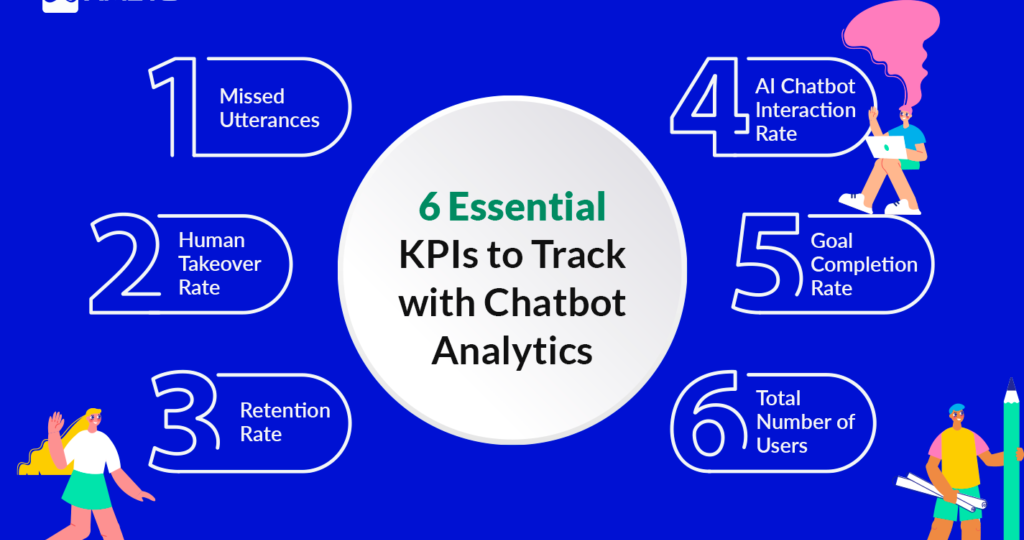
Below are the 6 essential chatbot KPIs every modern business should track, why they matter now, and how AI-powered analytics tools make this easier (and smarter) than ever.
1. Chatbot Engagement Rate
Are people actually talking to it—or ignoring it like a bad pop-up ad?
What it measures:
The percentage of visitors who interact with your chatbot after seeing it.
Why it matters in 2026:
With shorter attention spans and stricter privacy expectations, users only engage with tools that feel relevant, helpful, and human. A low engagement rate often signals:
- Poor timing or placement
- Generic opening messages
- Lack of personalization
How to improve it:
- Use behavior-based triggers (scroll depth, page intent, exit intent)
- Personalize greetings using AI (location, returning visitor logic, traffic source)
- A/B test opening messages regularly
Pro tip: Tools like GA4, Intercom, HubSpot, and Drift now integrate chatbot engagement data directly into your funnel analytics—use that.
2. Conversation Completion Rate
Do users finish the conversation… or bail halfway through?
What it measures:
The percentage of chatbot conversations that reach a defined goal (booking a call, submitting a form, getting an answer).
Why it matters:
A high drop-off rate usually means:
- Too many questions
- Poor conversation flow
- The bot sounds robotic or confusing
AI-driven chatbots today should adapt mid-conversation, not force users down rigid scripts.
How to improve it:
- Shorten paths to value
- Use AI intent recognition instead of keyword-only logic
- Clearly state what the user will get before asking for information
3. Lead Qualification Rate
Is your chatbot generating real opportunities—or just collecting emails?
What it measures:
How many chatbot-generated leads meet your qualification criteria.
Why it matters:
More leads ≠ better leads.
Smart businesses track lead quality, not just volume.
Modern chatbots can now:
- Score leads in real time
- Route high-intent users directly to sales
- Sync with CRMs automatically
Best practice:
Track chatbot leads inside your CRM (HubSpot, Salesforce, Zoho) and compare them against other channels. You’ll often find chatbot leads convert faster when done right.
4. Conversion Rate from Chatbot Interactions
Does your chatbot actually drive revenue or action?
What it measures:
The percentage of chatbot users who complete a desired action:
- Book a call
- Make a purchase
- Request a quote
- Subscribe
Why it matters now:
With rising ad costs and tighter budgets, your website must convert better—not just look good.
A well-optimized chatbot often outperforms static forms because it:
- Reduces friction
- Builds micro-trust
- Answers objections instantly
Advanced move:
Use AI to analyze conversation patterns that lead to conversions—and replicate them across your site.
5. User Satisfaction Score (CSAT or Sentiment Analysis)
Did the chatbot actually help—or just annoy people politely?
What it measures:
User feedback via ratings, surveys, or AI-powered sentiment analysis.
Why it matters in a privacy-first world:
Trust is currency.
If users feel misunderstood, misled, or frustrated, they won’t convert—no matter how clever your funnel is.
Modern AI tools can now:
- Detect frustration signals
- Flag poor conversations automatically
- Continuously improve responses using real data
Keep it human:
A simple “Was this helpful?” still goes a long way.
6. Bot-to-Human Handoff Success Rate
Does the transition feel seamless—or painfully awkward?
What it measures:
How effectively conversations move from chatbot to human support when needed.
Why it matters:
AI is powerful—but knowing when not to use it is even more powerful.
A poor handoff kills trust instantly.
What to track:
- Time to human response
- Context transfer accuracy
- Conversion or resolution after handoff
Best practice:
Your chatbot should never feel like a dead end. It should feel like a smart concierge.
Why Chatbot Analytics Are a Competitive Advantage (Not Just “Nice to Have”)
Chatbots are no longer experimental. They’re infrastructure.
When paired with the right KPIs and AI-driven insights, they become:
- Conversion optimization tools
- Customer experience accelerators
- Scalable sales assistants
At ONEWEBX, we don’t just install chatbots—we design conversion-focused conversational systems that integrate with your brand, your data, and your growth goals.