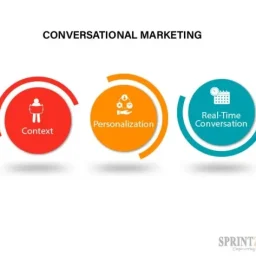


Conversational marketing is the use of real-time, two-way interactions across websites, messaging platforms, email, voice interfaces, and social channels to guide users through their journey.
It blends:
- AI-powered chat and assistants
- Personalized UX flows
- Context-aware automation
- Human handoff when it matters
The goal isn’t to sound human.
The goal is to be helpful, relevant, and frictionless.
Why Conversational Marketing Has Exploded
Three forces are driving the shift.
1. AI Finally Got Good (and Practical)
Thanks to advances in generative AI and natural language processing, conversational tools can now:
- Understand intent, not just keywords
- Respond with contextual, on-brand language
- Pull from CRMs, knowledge bases, and live data
- Learn from interactions without being creepy
This means conversations can scale without losing clarity or control—especially for small and mid-sized businesses.
2. Customers Expect Instant, Personalized Interaction
Today’s users don’t want to:
- Dig through menus
- Wait for email replies
- Fill out generic forms
They want answers now, in plain language, on whatever device they’re holding.
Conversational marketing meets modern expectations:
- Fast
- Personalized
- Accessible
- Low-effort
If your site can’t respond, users bounce—to one that can.
3. Privacy Laws Changed How We Build Trust
With GDPR, CCPA, and a cookieless future fully in motion, brands can no longer rely on passive tracking alone.
Conversational interfaces let users voluntarily share intent, which is:
- More accurate
- More ethical
- More conversion-friendly
Trust is built through transparency—and conversation is one of the most transparent UX tools available.
Where Conversational Marketing Shows Up in 2026
This isn’t just about website chat bubbles anymore.
Key Touchpoints:
- AI chat on websites (sales, support, onboarding)
- Conversational landing pages that adapt to user input
- SMS and WhatsApp automation for high-intent follow-ups
- Conversational email flows that feel human, not scripted
- Voice-enabled search and assistants optimized for natural language
The best brands create a connected conversation, not isolated tools.
The UX Shift: From Funnels to Dialogues
Traditional funnels assume linear behavior.
Real users are anything but linear.
Conversational UX allows users to:
- Ask instead of search
- Skip steps they don’t need
- Self-qualify in seconds
- Get routed to the right solution faster
This reduces friction, boosts accessibility, and dramatically improves conversion rates—especially on mobile.
AI + Conversational Marketing = Smarter Strategy
In 2026, AI doesn’t just respond—it anticipates.
Modern conversational systems can:
- Predict user intent
- Suggest next best actions
- Personalize responses by segment or behavior
- Identify sales-ready vs research-mode users
- Optimize scripts based on performance data
The result? Fewer dead-end interactions and more meaningful outcomes.
SEO Isn’t Dead—It’s Conversational Now
Search behavior has shifted from keywords to questions.
Thanks to AI-driven search and voice interfaces, brands must now optimize for:
- Natural language queries
- Long-tail, conversational phrases
- Direct answers
- Structured, accessible content
Modern SEO tools like SEMrush, Ahrefs, Google Search Console, and AI content analyzers help identify how real people phrase real questions—fueling both conversational content and chat logic.
Common Mistakes Brands Still Make
Even in 2026, many brands get conversational marketing wrong.
Avoid:
- Over-automating with no human fallback
- Generic chatbot scripts that don’t reflect brand voice
- Ignoring accessibility (screen readers, keyboard navigation, clear language)
- Treating chat as a gimmick instead of a strategy
- Forgetting to connect conversations to CRM and analytics
Conversation without context is just noise.
Why Conversational Marketing Is a Power Move for Businesses
When done right, conversational marketing:
- Shortens sales cycles
- Improves lead quality
- Increases user trust
- Reduces support workload
- Creates memorable brand experiences
It’s not about talking more—it’s about listening better.
How ONEWEBX Approaches Conversational Strategy
At ONEWEBX, we don’t bolt chat tools onto websites—we design conversations into the experience.
Our approach blends:
- UX/UI design
- AI automation
- SEO and content strategy
- CRM and analytics integration
- Conversion-focused messaging
The result? Websites that don’t just look good—they respond, guide, and convert.