
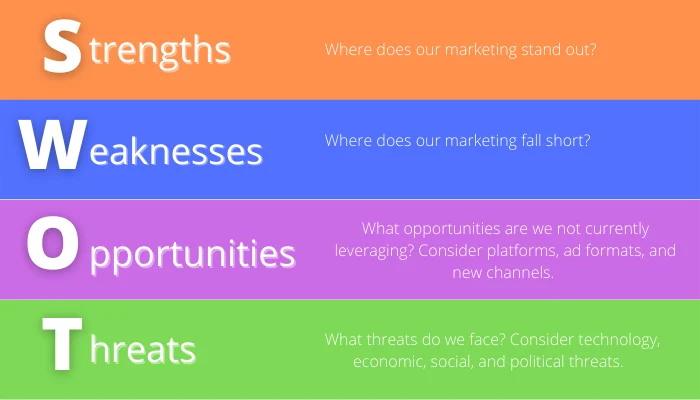
Enter the SWOT analysis—your secret weapon for turning chaos into strategy. But let’s be real: a SWOT is only as valuable as the insights and actions it produces. Done wrong, it’s just a fancy checklist. Done right, it’s a strategic compass.
Here’s how the ONEWEBX team approaches a marketing SWOT analysis for a new client in today’s digital-first, AI-driven landscape.
Step 1: Define the Scope of Your Analysis
Before you open your dashboard or spreadsheet, get clear on what you’re analyzing. Ask:
- Which product, service, or business unit are we focusing on?
- Who are the target audiences and personas?
- Are we looking at digital marketing only, or full omnichannel performance?
This step sets boundaries. In 2026, with AI and automation, you can pull in hyper-relevant datasets from multiple sources (Google Analytics 4, HubSpot, SEMrush, Ahrefs, Sprout Social) to make your SWOT laser-focused.
Step 2: Uncover Strengths
Strengths are what your client does better than anyone else, internally and externally. In the modern context, consider:
- Digital Presence: High-performing website UX/UI, accessibility, and mobile experience
- Content & SEO Assets: Blogs, videos, podcasts, and AI-generated content pipelines
- Brand Authority: Social proof, partnerships, and online reviews
- Tech Stack & Automation: CRM efficiency, AI tools for content generation, social listening, and workflow automation
Tools like SEMrush, Ahrefs, and HubSpot AI insights make this easier by showing what’s working organically, what content drives engagement, and where automation has optimized performance.
Step 3: Identify Weaknesses
Every business has them—your job is to spot critical friction points that limit growth. In 2026, think about:
- Slow website performance or poor Core Web Vitals
- Weak conversion paths or poor UX
- Gaps in accessibility or inclusive design compliance (WCAG 2.2)
- Lack of AI adoption in marketing workflows (e.g., automated content optimization, personalized email sequences)
- Low brand visibility in search or social
You can combine AI tools with human insights to uncover weaknesses that aren’t obvious in standard analytics.
Step 4: Spot Opportunities
Opportunities are about future growth, not just current wins. Modern marketers should look at:
- Emerging social platforms or content formats (short-form video, AR/VR experiences)
- AI-powered personalization and automation in campaigns
- Untapped keywords or content clusters discovered via tools like Surfer SEO or MarketMuse
- Partnerships, collaborations, and influencer ecosystems
- Behavioral trends and shifting consumer preferences post-cookie era
The key: align opportunities with measurable KPIs like engagement, conversions, and revenue growth.
Step 5: Recognize Threats
Threats are external factors that can undermine your client’s success. Consider:
- Competitor content strategies and paid media dominance
- Rapidly changing privacy regulations (GDPR, CCPA, AI-driven data concerns)
- Algorithm shifts in search or social platforms
- Saturation in certain content verticals
- Rising costs of ad placements or influencer partnerships
Using AI-powered competitive analysis tools like SEMRush, SimilarWeb, or Sprout Social Insights helps you predict threats before they hit.
Step 6: Turn SWOT Insights Into Action
Here’s where many agencies fall short: SWOTs are useless if they don’t inform strategy. For each element:
- Strength → Leverage it: Amplify high-performing content, UX, or automation.
- Weakness → Fix it: Prioritize issues that block conversions or engagement.
- Opportunity → Capitalize: Use emerging platforms, AI workflows, and trend insights to expand reach.
- Threat → Mitigate: Build contingency plans for competition, algorithm changes, or market shifts.
The result: a roadmap that ties digital performance, content strategy, and UX design directly to business goals.
Step 7: Visualize and Share
A SWOT isn’t just an internal tool. Present it in a visually clear, actionable format:
- Use diagrams or quadrant charts
- Layer in KPIs, AI insights, and trend data
- Highlight top priorities per quadrant
Pro tip: Include a client-facing narrative. Show not just what you found, but how it will drive results. Decision-makers respond to clarity + confidence.
Why Modern SWOT Analysis is Essential in 2026
With AI tools, automated dashboards, personalized content strategies, and rapidly evolving digital channels, a SWOT analysis:
- Helps you see the full picture, not just surface-level metrics
- Connects UX, SEO, content, and social strategies
- Provides a data-driven roadmap for measurable results
- Establishes trust with clients through actionable insights
At ONEWEBX, a well-executed SWOT is more than a report—it’s a launchpad for growth.